Products
The Products section allows you to create and manage individual products that will be available in the Android application for ordering. Each product must be assigned to a product group in order to be visible and selectable from the application.
Products added here form the core of your menu, and their configuration directly affects ordering behavior, availability, pricing, and printing.
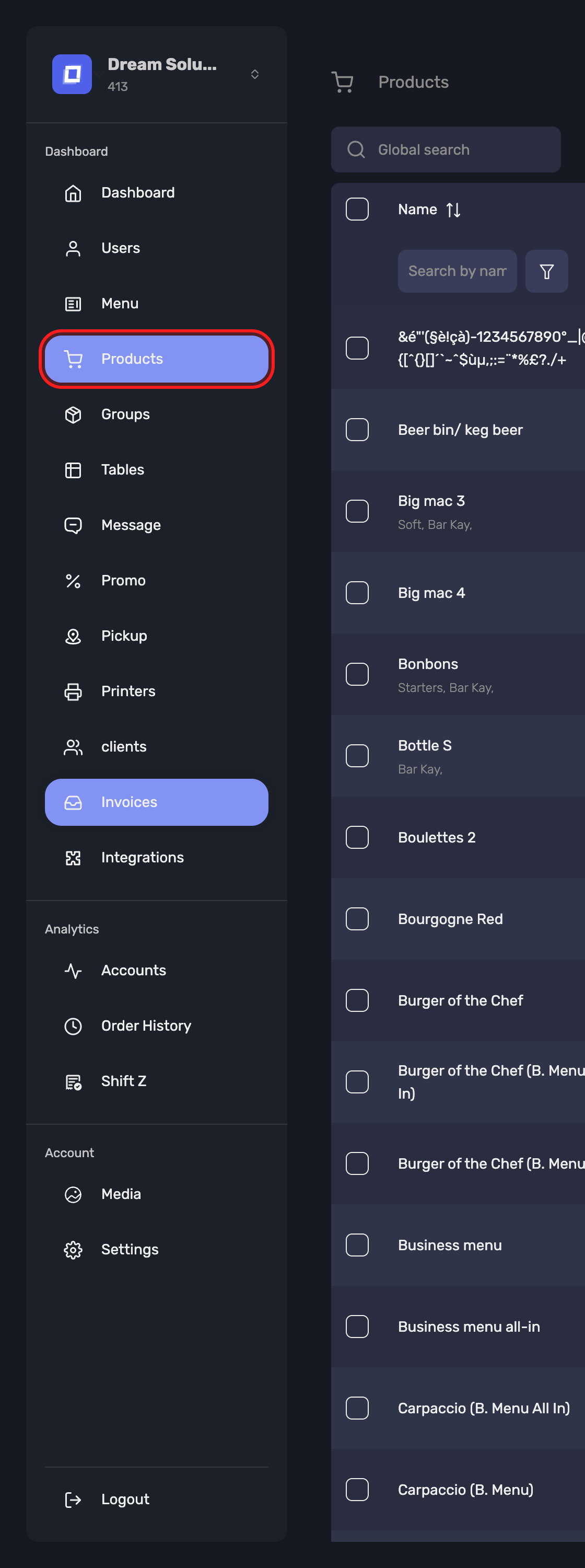
Open it from Products in the sidebar.
Creating a Product
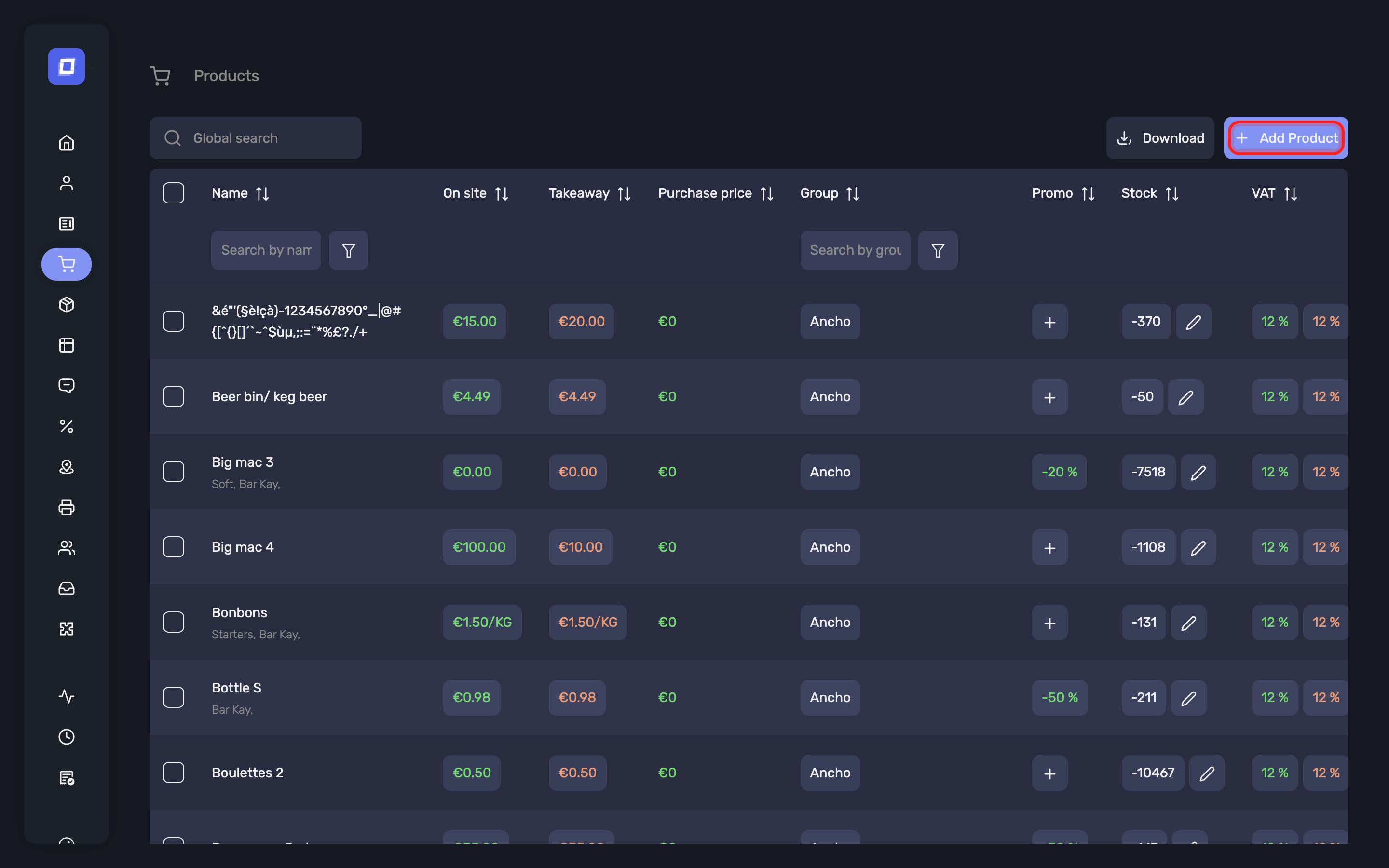
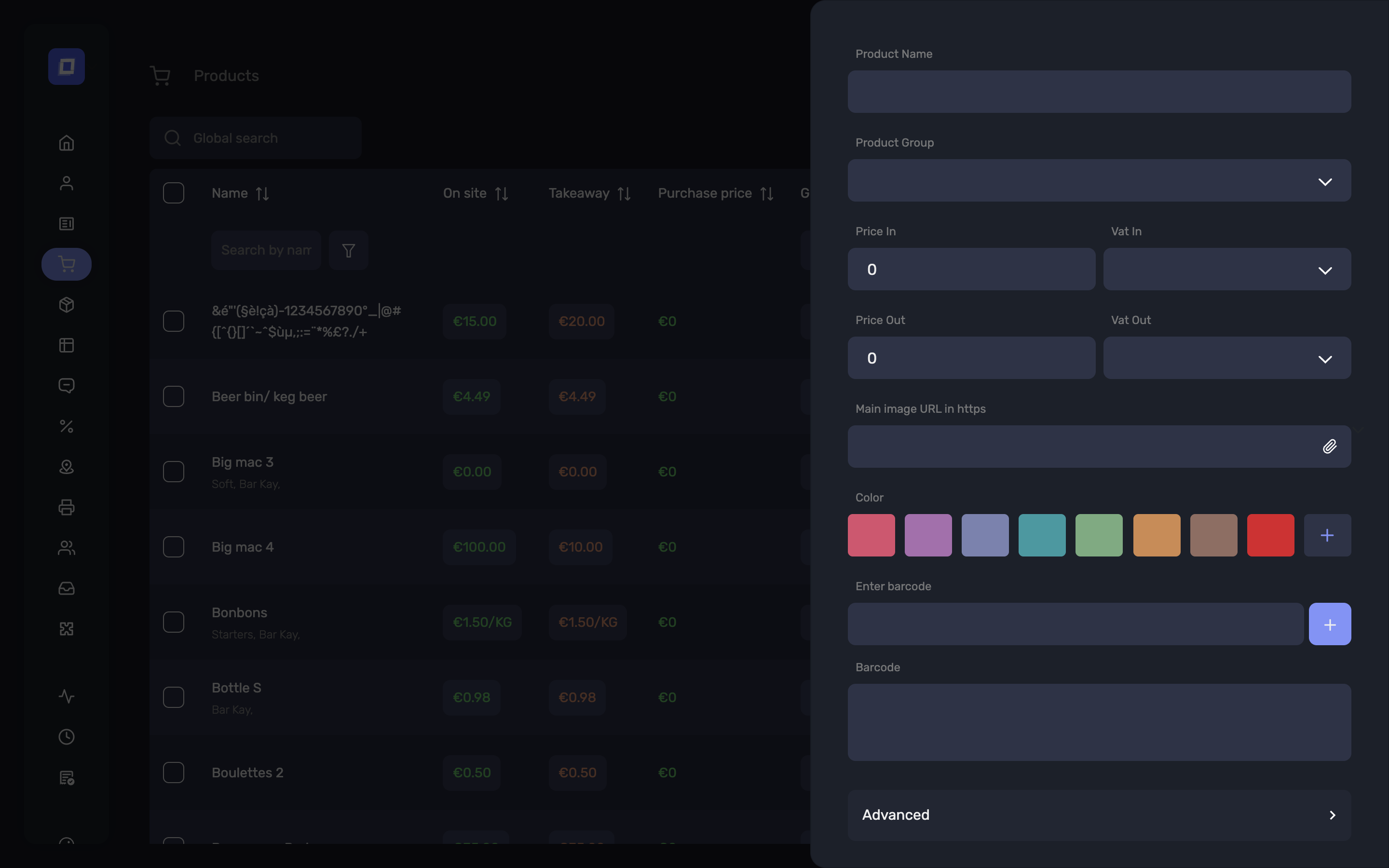
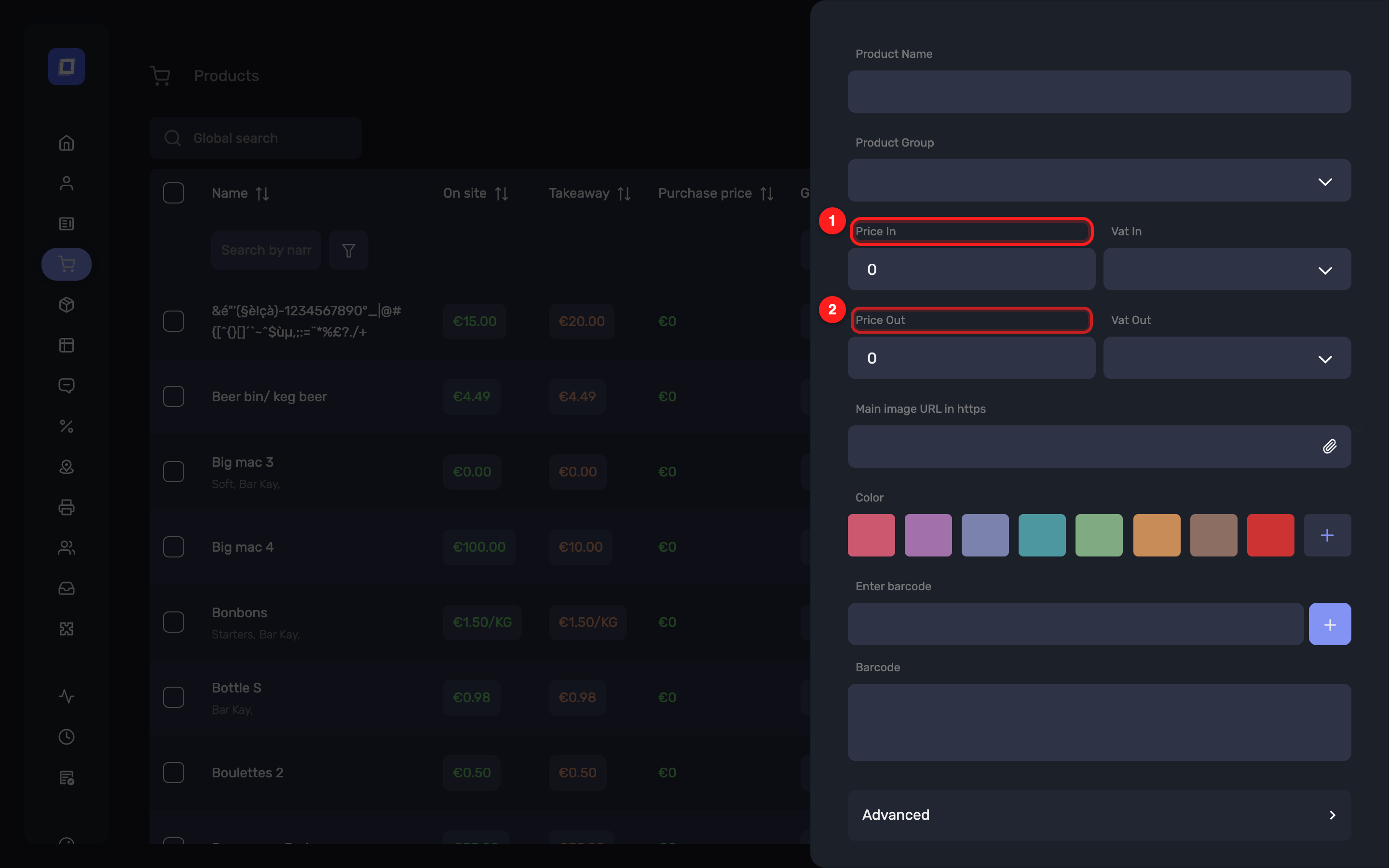
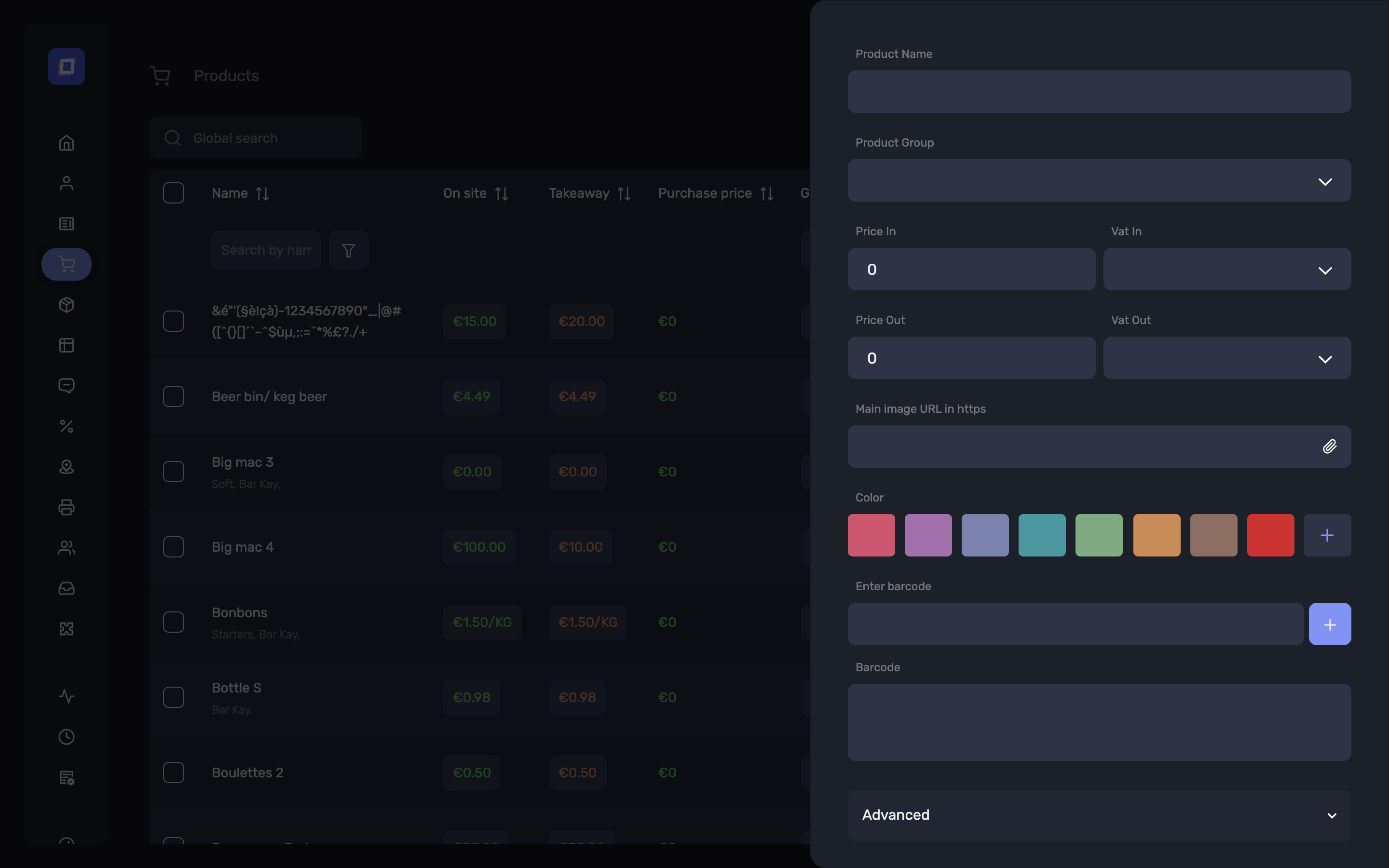
When creating a product, the following fields are available:
Product Name
The name as it will appear in the app and admin panel.
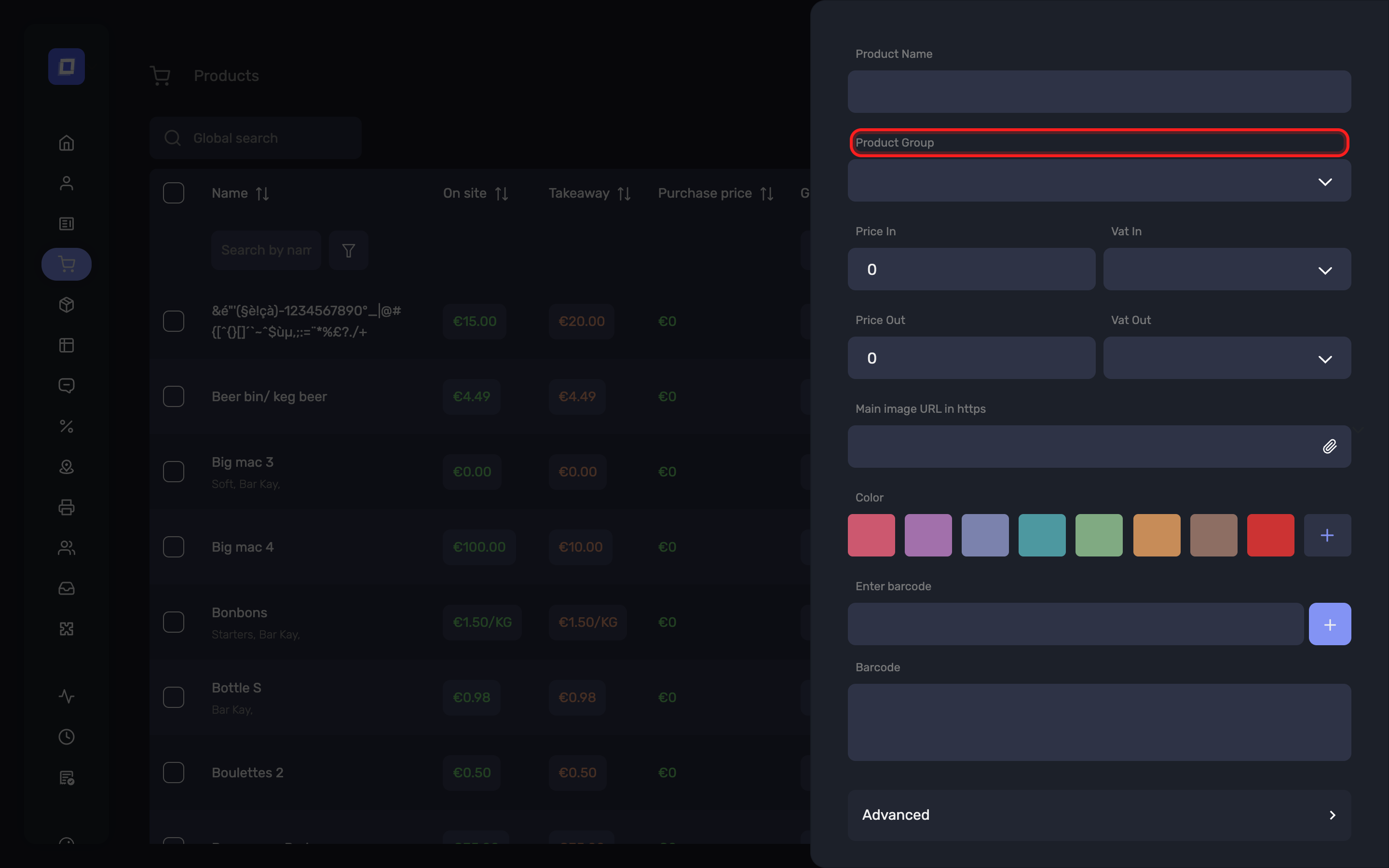
Product Group
The group (department) this product belongs to. This determines visibility, printer routing, and group-based behaviors.
Price In / Price Out
Define pricing for in-house (Price In) and takeaway (Price Out) contexts.
VAT In / VAT Out
VAT applicable to in-house and takeaway orders, respectively.
How you set it depends on your version:
- International — you pick the rate: 21%, 12%, 6%, 0%.
- Belgian SCE-certified — you pick the fiscal letter, which carries the rate with it: A (21%), B (12%), C (6%), D (0%) or X (-). These are the letters printed on the VAT ticket.
Stock
Optional. If enabled, stock will decrement automatically when the product is ordered.
Order
Determines the position of this product within the list of products in its assigned group.
Purchase price
What the product costs you, excluding VAT.
This is not shown to customers and does not affect the selling price or the till. It exists so the panel can put cost next to revenue when you are looking at what a product is actually worth selling.
Tip
Filling this in is optional, and it is only as useful as it is current. If you set it once and never revisit it after supplier prices move, it will quietly mislead you — either keep it up to date or leave it empty.
Timed Product
Marks the product as available on an hourly basis.
Note
The field is not shown in the Belgian SCE-certified version.
Allow Decimal Units
Enables ordering the product in fractional quantities (e.g., 0.5 kg).
Dynamic Price
Allows the price to be entered manually at the time of ordering, overriding the pre-set value.
When enabled, the price configured in the Admin Panel will be ignored during order creation.
Warning
A dynamic-price product cannot be ordered on a self-ordering kiosk. The customer has no way to set a price, so the product is not offered there.
Weight Price
Indicates whether the product's price is calculated based on weight.
Hide on app?
Hides the product from the application without deleting it. The product can still be used as a paid or free option on a composed product.
Hide on website?
Hides the product from the webshop, without hiding it in the POS application.
Fixed Promotion (%)
Applies a percentage-based discount directly to the product.
The original price and the deduction are both shown on the VAT and summary tickets — see Payment → Promotions on Tickets.
Color
Optional display color for quick identification in the UI.
Multilingual Descriptions
You can provide product descriptions in up to three different languages.
Barcode
Used to enable barcode scanning for quick product selection.
Image URL & Extra Images
Add one or more image URLs to visually represent the product. Files are uploaded in the Media section.
Allergens
Select the allergens that apply to the product. The available symbols are managed in the Icons section, where each one carries its name per language.
Working with the Product List
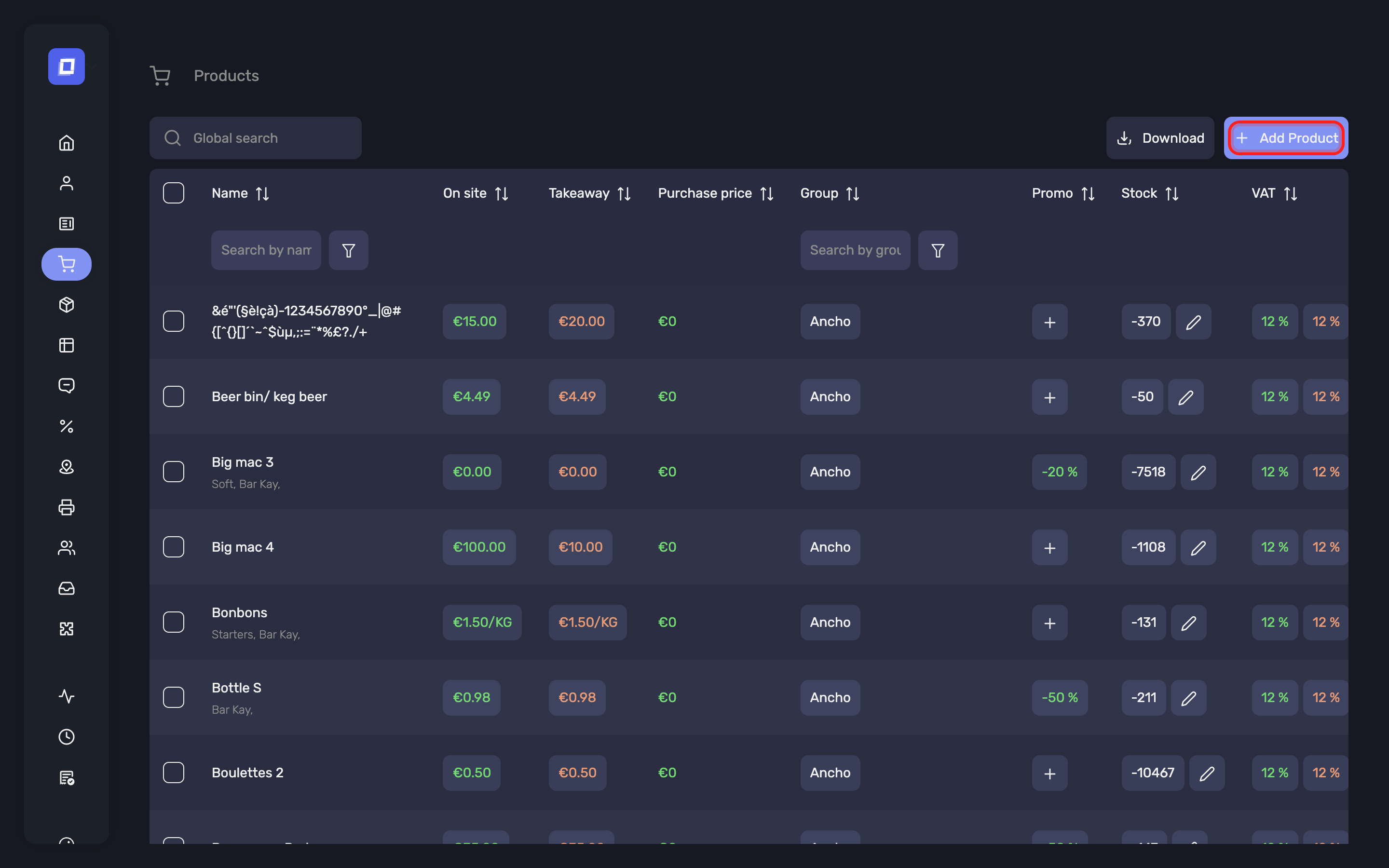
The product list is built for large catalogs:
- Search and sort on any column, including Barcode — useful when checking scanned codes for duplicates or gaps.
- Filter by parent group directly from the column header, to work through one department at a time.
- Select several products and edit them together. The bulk edit dialog covers the Image URL as well, so a whole group of products can be given their image in one action.
Tip
Bulk edit is the fastest way to apply a change that is identical across many products — a VAT rate, a group move, or an image. Filter the list first, then select and edit.
Note
If your user is restricted to specific Product groups, this page shows only the products of those groups, and editing, importing or deleting outside them is refused. See Users → Product Groups.
Importing Products
The Import CSV action opens a guided import that walks through five steps:
- Import Files – browse and upload your file. CSV is the supported format.
- Data Mapping – select the data to bring in and map it.
- Group Review – check the product groups that will be created.
- Entity Mapping – confirm how your columns fill the product fields.
- Summary – review everything, then confirm.
Four import modes are available:
| Mode | What it does |
|---|---|
| Inter-org import | Duplicates all products from one establishment to another. |
| External CSV import | Adds products from an external CSV file. |
| Add to existing groups | Adds products into the groups identified in the file, creating a group when it does not exist yet. |
| Update import | Updates products that already exist in the same establishment. |
Tip
Run an import on a quiet moment and check the Summary step carefully — it is the last point at which the import can still be abandoned without touching your catalog.
Warning
Update import overwrites the values of existing products. Export or note your current prices before running it if you are not certain of the file's content.
Product Group Options (Composed Products / Menus)
The Product Group Options section allows you to link other product groups to a main product. This is used to build composed products or menus.
When a user selects the main product in the app, they will be prompted to choose products from the specified groups.
Free Options
Products selected from these groups are included in the menu at no extra cost.
Paid Options
Products selected from these groups will have their price added to the total.
Multi-Choice
Determines whether the user can select one or multiple products from the linked group.
Tip
To further control how many items a user can choose from a group, refer to the Max paid in sub group and Max free in sub group settings in the Product Groups configuration.